
The Legend of The Chained Oak & The Beautiful Village of Alton
This year, as in previous years, thousands of people will flock to Alton Towers for Scarefest, where at least one ride and visitor experience—Hex—has its roots firmly planted in a local legend. While the concept of an experimenting Earl may be attributed to creative or commercial license, the legendary tree clad in chains still stands, acting as a beacon of curiosity and puzzlement for all who pass by under its shaded canopy. It is a tangible, living testament to a folk tale that is quite unlike anything else found not only in the British Isles but also much further beyond.
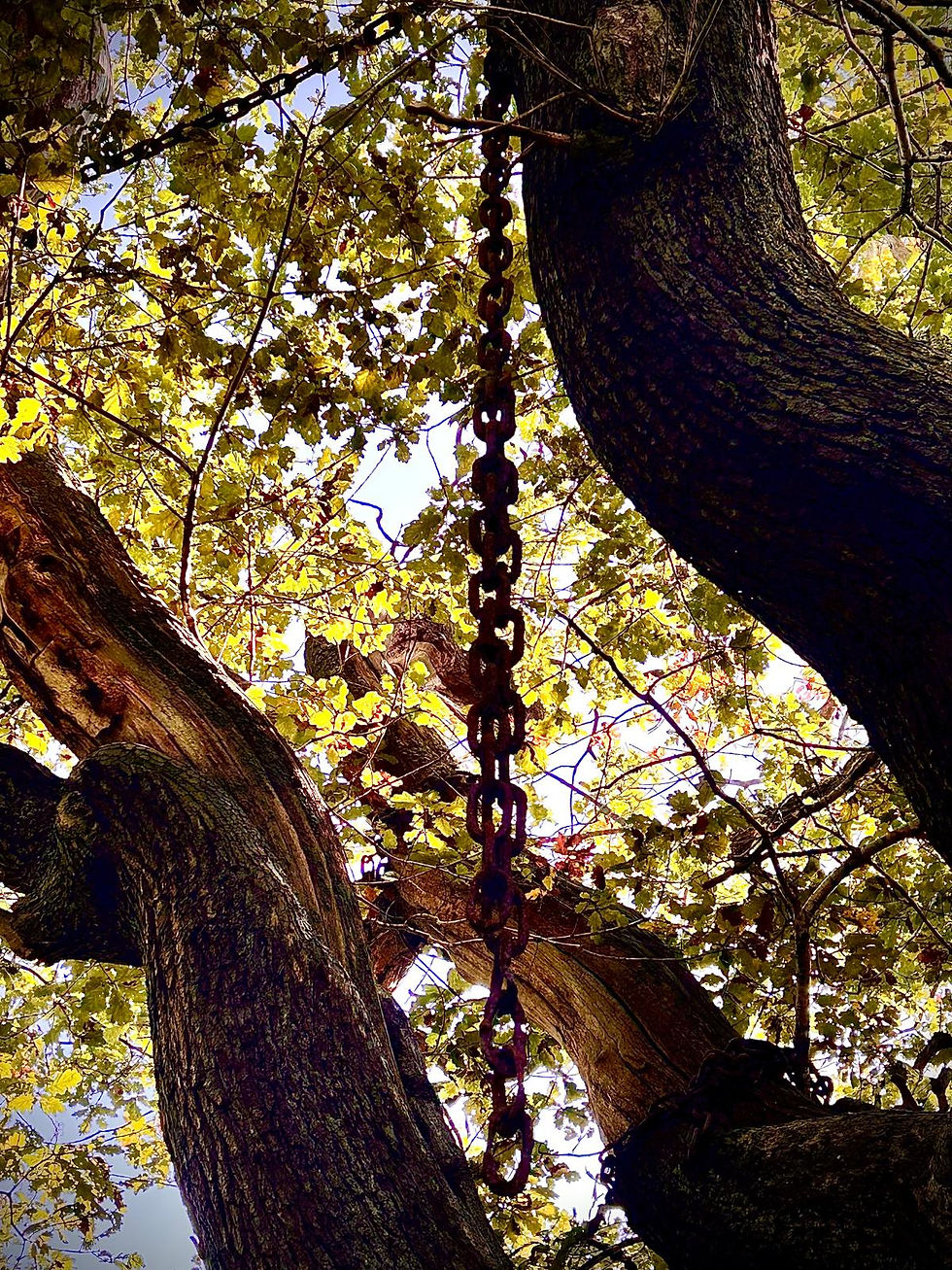
The Chained Oak Legend
According to local legend, it was along a public footpath to the left, where the Chained Oak B & B is now located—approximately half a mile from Alton Towers—that the 16th Earl of Shrewsbury, John Talbot, was traveling home to Alton Towers in the mid-1800s. During his journey, his carriage was halted by an old beggar woman. Recognizing the earl, she requested some coins but was turned away.
Aggrieved, she pointed up to an oak tree on the slopes beside the trackway. From that night forth, she said, for every branch that fell from the oak, a member of the earl's family would die. That very same night, a storm broke across the valley and duly caused a branch to break free from the oak, and the following morning, Talbot woke up to the news that a member of his family had suddenly passed away in the night. The Earl immediately ordered his guards to chain the tree up to prevent further misfortune.
Variations of the story exist; some say that it was an old man who cursed the earl, not a woman, and that instead of a storm bringing down a branch, the Earl’s son was out riding the next day and, as he passed the old oak tree, the woman had been standing under a branch which fell on top of him, knocking him from his horse, which ended his life.

This 700-year-old oak tree was a finalist for the Woodland Trust's Tree of the Year in 2020 and was noted as being in decline at that time.
Perhaps even more mysterious than the legend of the chained oak is the convenient set of 20 steps leading up to the ancient oak. Can we assume that our ancestors hauled these large stones to create a better viewing position of this mysterious tree? Given the legend, it seems unlikely that John Talbot or a later family member would want to provide better access to something they had gone to great lengths to protect themselves from. Is it possible that the steps were placed to lead people to something else? A considerable effort would be involved in getting them to the spot, so our ancestors must have had a good reason for their placement.
The tree, which is in serious decline, has shed a number of its branches over the years, and the Talbot family, at the last incident of a breaking branch, confirmed that no death had so far occurred as a result.
Was the beggar woman merely knowledgeable about trees? Perhaps she spotted a branch about to fall and used the curse as a convenient method of what we now refer to as scamming. Considering that the oak was highly likely to outlive the Talbot family members of that era, the beggar would be predicting a probable outcome. It is known that the Talbot Earls planted numerous trees and took care of those already there, which might explain why the tree was chained instead of burned—a more logical conclusion for something that posed a threat to their survival.

Whatever the reason the Oak was chained, this remarkable tree and its neighbouring steps are well worth a visit, particularly if you plan to ride Hex. Barbary Gutter, as it is called on the old Ordnance Survey maps, is a beautiful part of Staffordshire's amazing woodlands and is free to visit. If you do decide to visit the ancient oak, please be aware that at 700 years of age, it is very, very old even by oak tree standards, so please refrain from touching the tree. Being able to gaze at the metal chains and the magnificence of this beautiful old tree makes this a very special place.
.
The Beautiful Village of Alton
Outside of the feverish adventures to be had at Alton Towers during October, there is a lot more to the village of Alton than most of its visitors will likely have the chance to realize. More than 50 listed buildings are dotted along its roads and lanes, ranging from the twelfth-century St. Peter's Church to the village lock-up built in 1819. The village is home to an enviable architectural collection that vividly conveys the changing nature of its rich history.
Alton Castle finds its structural origins in the early twelfth century as part of the great building project undertaken by the incoming Norman lords following their conquest of 1066. However, many of its features that first appear to be of that period actually stem from its nineteenth-century remodeling, when the 16th Earl of Shrewsbury commissioned the revered architect Augustus Pugin to revamp the site in the style of a Teutonic stronghold, as well as the glorious Pugin Church of St. Giles in Cheadle, built in 1841-1845.
This refurbishment saw the previous building, which was heavily damaged during the English Civil War, rebuilt complete with a hospital and presbytery in a truly grand design.
The 16th Earl, John Talbot, was clearly a fan of such projects. The castle wasn't even his official residence. Talbot was perfectly happy with his life at the nearby Alton Towers estate, which had been built by his uncle Charles in the early 1800s, the grounds of which made for one of the largest formal landscaped gardens in the whole of Britain.

The Legend of The Chained Oak & The Beautiful Village of Alton


